This is an old revision of the document!
ChipIr
References
Beam Parameters
| Beam Source | Particle Type | Flux ($cm^{-2} s^{-1}$) | Energy | Notes |
|---|---|---|---|---|
| Proton Spallation | neutron | $5\times 10^{6}$ | 10-800 |
Facility
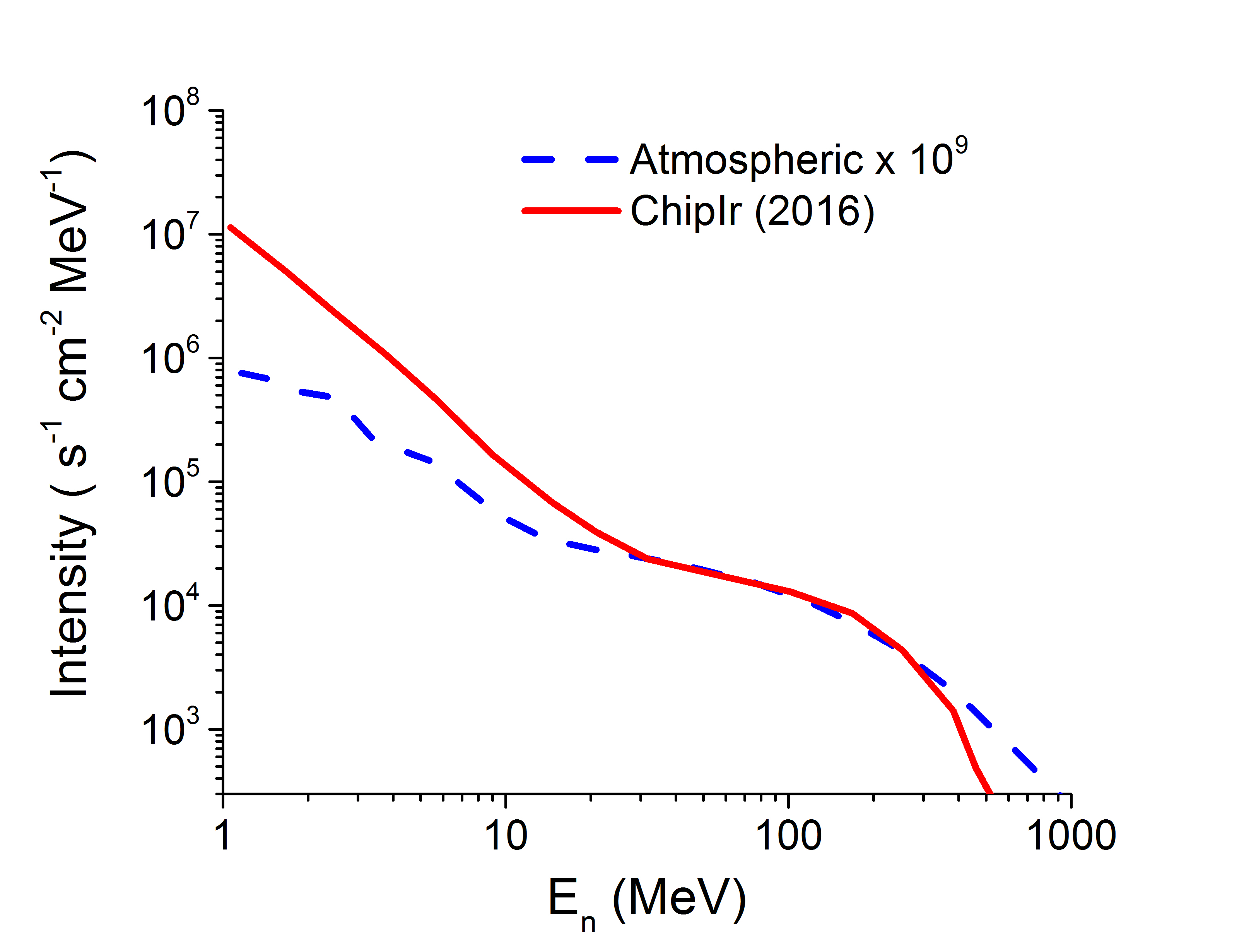
ChipIr is a beamline at the Rutherford Appleton Laboratory. It was designed for the purpose of studying single event upsets (SEE) of microelectronics. The studies are performed with neutrons whose spectrum resembles that of atmospheric neutrons. The intensity can be increased by a factor up to $10^{9}$ depending on the configuration.
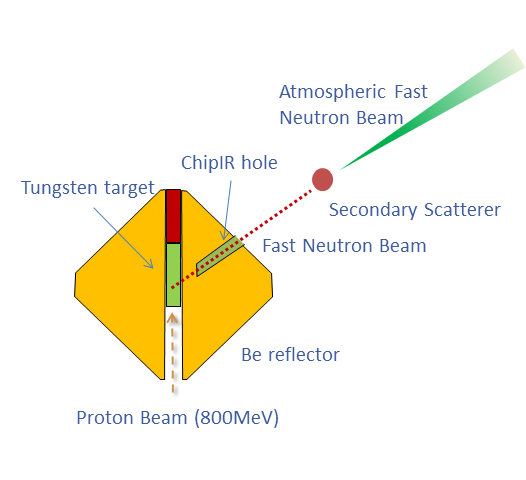
Neutrons are produce by accelerating protons up to 800 MeV. These are then injected into a tungsten target, producing secondary neutrons. Through hydrogenous moderators to a variety of instruments the neutron spectrum simultaneously includes thermal and cold neutrons. The fast neutron beamline is extracted through the addition of a new channel in the beryllium reflector. Neutrons from this channel illuminate a secondary scatterer made to optimize the hard atmospheric-like neutron spectrum. With an independent shutter the neutron beam can be closed and opened while the accelerator is running. The schematic is shown below.
Neutron Spectrum
The resulting neutron spectrum look like the figure below.
Beam Profile
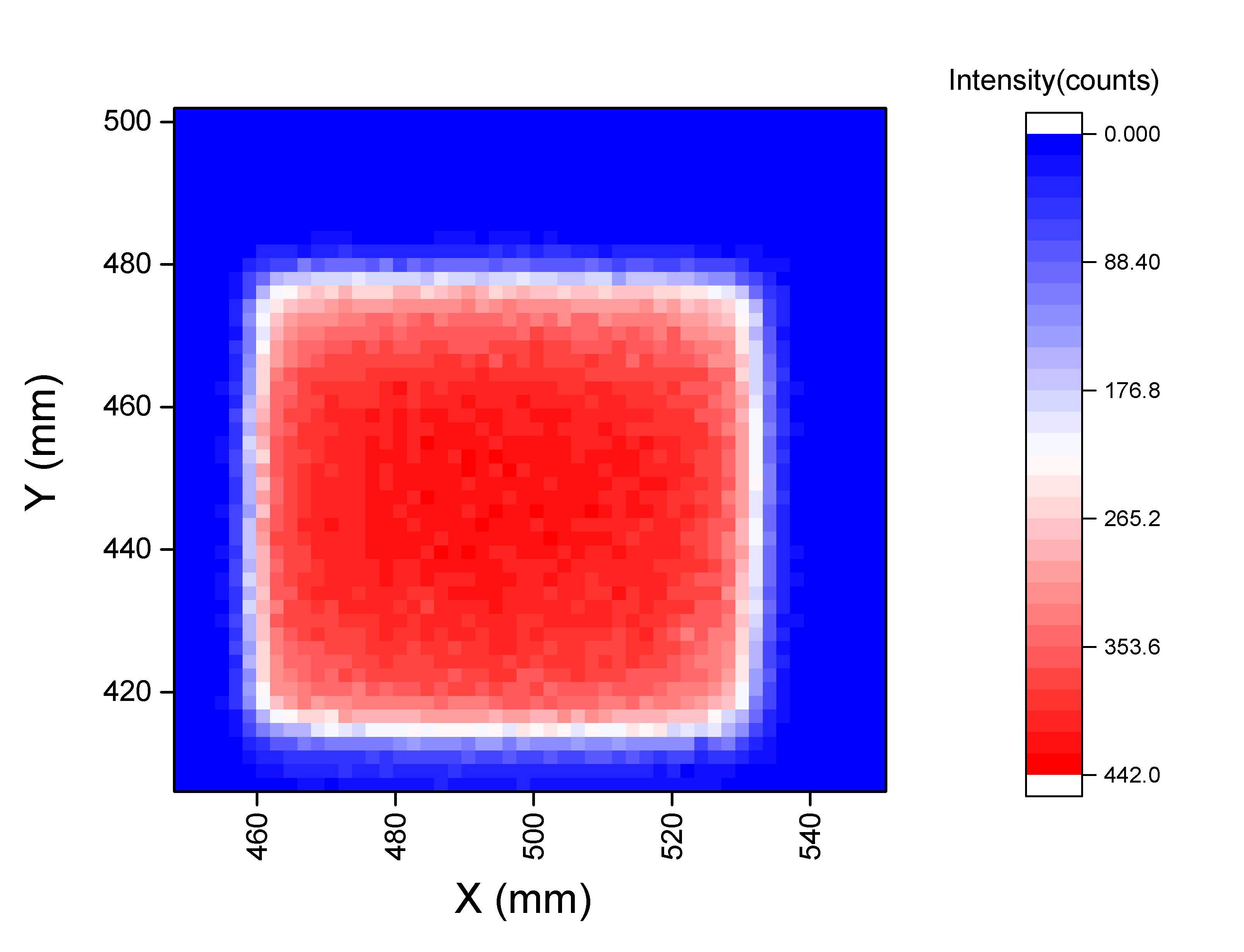
The collimator system provides flexibility with respect to the beam size. The beam size ranges from 1m x 1m down to a few $cm^2$. The figure below shows the beam uniformity profile for a beam size of 70mm x 70mm (typical order of magnitude for electronics size). As shown below, the beam is mostly uniform within the 2% level.